7 Signs Your Tree Needs to Be Removed: A Certified Arborist's Guide
At a Glance
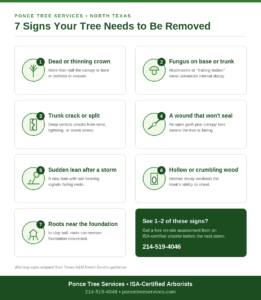
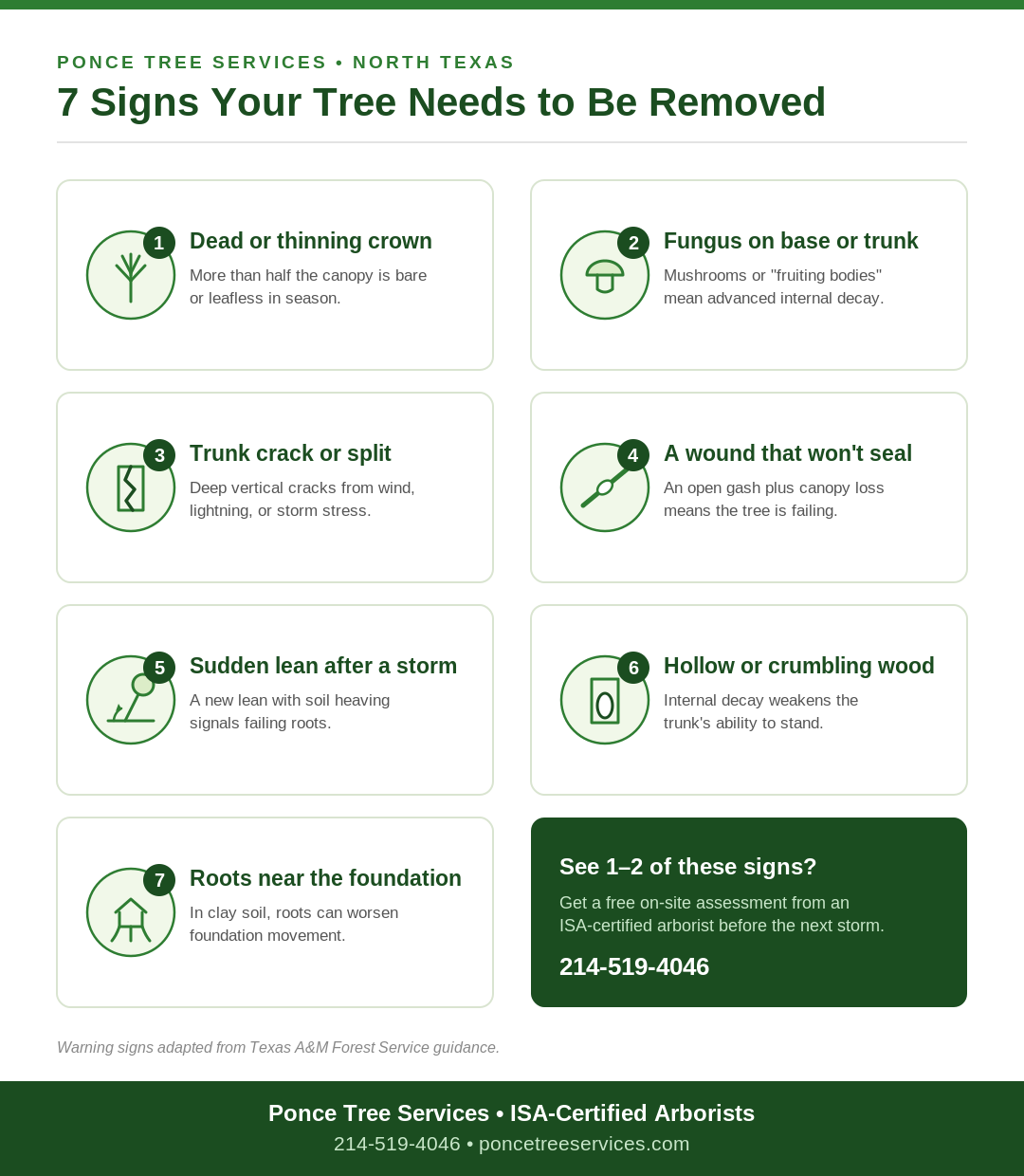
Seven signs your tree needs to come down:
- More than half the crown is dead or thinning
- Fungus or mushrooms are growing on the base or trunk
- A deep crack or split runs through the trunk
- An open wound won't seal over
- The tree has taken a sudden lean after a storm
- The wood is hollow or crumbling inside the trunk
- Roots are damaging the foundation
The rule: One sign means watch it. Two or more usually means call an ISA Certified Arborist this week.
Most of the calls we get start the same way. A homeowner walks out for the morning paper, sees a limb on the driveway, and notices the tree above it looks "off." By the time they call, half the time the answer is still "this tree can be saved." The other half, the tree has been quietly dying for years and the limb on the driveway is the first warning shot.
This guide is the field checklist I use on every property visit across Dallas, Fort Worth, Arlington, Plano, Irving, and Frisco. Seven visible signs your tree needs to be removed, in plain English, with how to spot each one from your back patio. I'll also tell you which signs are "monitor" and which are "call a pro this week," because they are not all the same. For the broader background first, our complete guide to tree removal in North Texas covers the whole process from inspection to haul-off.
How Do You Know When a Tree Needs to Be Removed?
A tree needs removal when it shows two or more of these seven signs at the same time: more than half the crown is dead or thinning, fungus is growing on the base or trunk, the trunk has a deep crack or split, an open wound won't seal over, the tree has taken a sudden lean, the wood is hollow or crumbling, or the roots are damaging the foundation. A single sign is usually a "monitor and prune" situation. Two or more is a "call an arborist" situation.
The reason we look for a cluster of signs and not just one is that trees are genuinely resilient. A small dead branch is not a dying tree. A leaning trunk is not always a falling trunk. But when problems stack, the failure rate climbs fast. That's the difference between a $400 trimming job and a $3,000 emergency removal after the tree comes down on a fence.
Sign #1: Dead or Thinning Crown
If 50% or more of a tree's crown is dead or thinning, the tree is usually past the point of recovery and should be removed for safety. Watch for entire branches with no leaves in growing season, bare scaffolds that should be full of foliage, and "widow-maker" dead limbs hanging in the crown that can drop with no wind at all.
According to the Arbor Day Foundation, large dead branches in the crown can fall for seemingly no reason and seriously injure anyone below. Stand back 30 feet from your tree on a sunny day and look at the silhouette against the sky. If you can see daylight through more than half of the canopy in mid-summer, the tree is in serious decline.
Not sure whether a thin-looking branch is actually dead? Use the scratch test. Scrape a small strip of bark off a twig with a fingernail or pocket knife — green and slightly moist underneath means it's alive, brown and dry means it's dead. Gardening Know How recommends checking three to five spots around the tree before you draw a conclusion.
In DFW, dead canopy gets misread as "drought stress" all the time. Real drought stress recovers when the rain comes back. A tree that didn't leaf out by late April in North Texas is not stressed. It's done.
Sign #2: Fungus on the Base or Trunk
Mushrooms growing on the trunk or in a ring around the base of a tree mean the decay fungus is already inside the wood. By the time the fruiting body shows up, the rot has been working for years. The University of California IPM program notes that honey-colored Armillaria mushrooms and white fan-shaped mycelial mats under the bark are signs of advanced root rot.
What to look for:
- Honey-colored mushrooms in clusters at the root flare in fall or after rain
- Hard "conks" or shelf fungi growing directly on the trunk
- White, fan-shaped mats under loose bark near the base
By the time fruiting bodies are visible on the outside, the decay has usually been working inside the wood for years, and there is no fungicide that reverses it. Fungus on the trunk almost always travels with the next sign on this list — hollow or crumbling wood — and together they're a strong case for removal.
Sign #3: A Deep Crack or Split in the Trunk
Bark fissures are normal. Deep cracks that run vertically through the trunk and expose the wood underneath — from wind, lightning, or storm stress — are not. The same goes for "codominant stems," which are two trunks growing from the same point that form a V instead of a Y. Codominant stems are the single most common storm-failure pattern we see in DFW post oaks, Bradford pears, and live oaks.
A trunk that splits down the middle in a storm is very difficult to brace adequately, and most arborists will recommend removal rather than try to save it. The crack is a structural weakness that will fail again, usually worse, the next time the wind comes up.
Smaller cracks and weak unions can sometimes be addressed with cabling and bracing, which adds steel cable or rod support to share the load between stems. That works on healthy trees with a minor defect. It does not work on a tree that's already split.
Sign #4: A Wound That Won't Seal
Trees don't heal wounds the way we do — they seal them off, walling damaged wood away behind new growth. A healthy tree closes a small wound over a few seasons. A wound that stays open, keeps spreading, or has dead bark and dieback in the canopy directly above it is a tree that's losing the fight.
The triage rule from Iowa State Extension is that any wound removing more than one-third of the bark around the trunk's circumference is usually enough to require removal. That much missing bark interrupts the tree's ability to move water and nutrients up the trunk — it essentially girdles the tree.
Common culprits in DFW are storm-torn limbs that leave a long open gash, string-trimmer and lawnmower damage that rings the base over time, and old improper cuts that never closed. Watch the canopy directly above the wound: if those branches are thinning or dead while the rest of the tree is green, the wound isn't sealing and the tree is failing from that point up. If the wound is large or anywhere near a structure, get an on-site tree inspection before deciding.
Sign #5: A Sudden Lean After a Storm
A tree leaning more than 15 degrees from vertical is a removal candidate — but the real red flag is a lean that appeared suddenly, especially right after a storm. A leaning tree fails in wind much faster than a straight one because gravity is already doing half the work. Trees that have always leaned are usually fine. A trunk that tilted overnight is not.
Angi's tree removal guide puts the 15-degree threshold in writing, and it matches what we see in the field. The bigger tell is the soil at the base. If you see a "mound" pushing up on the opposite side of the lean, or cracks in the dirt around the root flare, the root plate is already lifting. That tree is days to weeks away from falling.
DFW clay soil makes this worse. Expansive clay swells when wet and shrinks when dry, which loosens the soil around the root flare every year. After a wet spring followed by a dry summer, we routinely find healthy-looking trees that have lost most of their root anchoring. A lean that wasn't there six months ago is a same-week call.
Sign #6: Hollow or Crumbling Wood
A tree can look fine up top and be hollow at the core. Internal decay eats the wood from the inside, and by the time it shows, the trunk has often lost much of the strength it needs to stay standing. This is the structural problem that fungus (Sign #2) warns you about from the outside.
Two quick field checks tell you a lot. Tap the lower trunk with the back of a hatchet or a mallet: a solid tree gives a sharp, full sound, while a hollow or decayed one sounds dull or drum-like. Then push a screwdriver into the wood near the base — if it sinks into soft, punky, crumbling wood instead of meeting firm resistance, the decay is advanced. The University of Maryland Extension notes that visible decay and trunk cavities usually mean the wood's structural integrity is already compromised.
A small, well-walled cavity on an otherwise vigorous tree isn't always a death sentence — an arborist can judge how much sound wood is left around it. But crumbling wood, a large hollow, or sawdust and carpenter-ant activity at the base mean the trunk can no longer be trusted near anything you care about.
Sign #7: Roots Damaging the Foundation
Roots are the hardest part of the tree to see and the most important to its stability. They become a removal issue in two ways: when they're dying — taking the tree's anchorage with them — and when they're large and close enough to a foundation to do damage. Watch for these root-trouble flags:
- Recent construction near the trunk. Trenching, grade changes, or driveway pours within the drip line cut roots and start a decline that may take 2 to 5 years to show in the canopy.
- Visible fungus at the root flare. The same decay warning as Sign #2, but at ground level.
- Heaving soil or exposed roots on one side. Often paired with a lean — a sign the root plate is lifting.
- Suckers or new shoots from the base. A stressed tree sometimes sends up sucker shoots as a survival response. That's a "something is wrong" signal, not a healthy growth pattern.
In DFW's expansive clay, big roots near the house make foundation movement worse: as roots pull moisture from the soil in drought, the clay shrinks and the slab settles unevenly. When a mature tree sits a few feet from the foundation and you're seeing new cracks in brick or drywall, removal is sometimes the only fix that protects the house. Trees that survived the 2023 drought are still showing root-driven canopy thinning today — if you had construction near a tree in the last 5 years and the crown is thinning now, root decline is the most likely cause.
When Should You Call an Arborist Instead of Removing It Yourself?
Call an ISA Certified Arborist any time the tree is within falling distance of a house, fence, power line, vehicle, or area where kids play. Anything over about 25 feet tall, anything within 20 feet of a structure, and anything with two or more of the seven removal signs above belongs to a professional. The cost of doing it wrong, in property damage or hospital bills, is multiples of what a quote runs.
A few specific "always call" scenarios:
- The tree is leaning toward a structure
- Mushrooms or conks are visible on the trunk
- The trunk is split or has a deep crack
- The trunk sounds hollow or the wood is crumbling
- The tree is over 30 feet tall
- Power lines run anywhere through the canopy
If you're trying to decide whether the tree is worth the cost of removal, our pricing guide on what tree removal actually costs in DFW breaks it down by tree size, species, and complexity.
Conclusion
A single warning sign on your tree is usually a "monitor and maybe prune" situation. Two or more of the seven signs in this guide, especially when one of them is a lean, a deep crack, or visible fungus, is a "call an arborist this week" situation. The cost of acting early is always less than the cost of cleaning up after a tree comes down on something you care about.
If you're not sure whether what you're looking at counts as a real warning sign, the easiest move is to skip the guesswork and get a real arborist on the property. Call Ponce Tree Services at 214-519-4046 for a free on-site inspection. An ISA Certified Arborist will walk your trees, tell you which ones can be saved, and give you written recommendations on the ones that can't. We serve Dallas, Fort Worth, Arlington, Plano, Irving, and Frisco across the DFW metro.
Frequently Asked Questions
Can a dying tree be saved instead of removed?
Sometimes. If the tree has only one warning sign and the rest of the canopy is healthy, treatments like fertilization, proper pruning, and pest management can extend its life. Trees with two or more signs from the list above, especially fungus or trunk splits, are almost never saveable. An ISA-certified arborist inspection is the only way to know which category your tree is in.
Can a tree with a hollow trunk be saved?
Sometimes. A small cavity with a thick wall of sound wood around it can stay stable for years, and an ISA Certified Arborist can estimate how much solid wood remains. But a large hollow, crumbling punky wood, or decay covering more than about a third of the trunk's cross-section usually means the tree can no longer support itself safely and should be removed — especially within falling distance of a house or driveway.
Do I need a permit to remove a dead tree in Dallas or Fort Worth?
It depends on the tree size, location, and city. Most DFW cities allow removal of confirmed dead or hazardous trees without a permit if a certified arborist documents the condition, but live trees over a certain diameter often require one. Our Dallas tree removal and Arlington tree services pages cover the local rules, and we handle permits for our clients when needed.
Is a leaning tree always dangerous?
No. Trees that have always leaned, especially those that grew toward a sunlight gap, are usually structurally sound. The dangerous lean is a recent one, where the angle has changed in the last year, or where you can see heaving soil or cracks in the dirt at the base of the trunk. A sudden lean after a storm or wet spell is always a same-week call.
How much does it cost to remove a dead tree in DFW?
Dead tree removal typically runs $800 to $1,600 in the DFW metro, somewhat higher than a comparable live-tree removal because dead wood is more dangerous to climb. Final price depends on tree size, access, and proximity to structures. Our full DFW tree removal cost guide breaks down pricing by size, species, and complexity.
Amaury Ponce is an ISA Certified Arborist and TCIA member with 20 years of tree care experience across the Dallas–Fort Worth metro. Ponce Tree Services is a family-owned, BBB-accredited, fully licensed and insured tree care company serving Dallas, Fort Worth, Arlington, Plano, Irving, and Frisco. Call 214-519-4046 for a free on-site inspection or visit poncetreeservices.com.