How Much Does Tree Removal Cost in North Texas?
At a Glance
Most tree removals in North Texas cost between $300 and $2,500:
- Small trees: $300 to $800
- Mid-size trees: $800 to $2,000
- Large mature trees: $2,000 to $5,000
- Crane-required heritage removals: $8,000 or more
Price comes down to height, trunk size, species, access, and how close the tree is to your house. Always get a written, itemized quote, and confirm the company carries general liability and workers' comp.
Introduction
The first thing every homeowner asks when a tree starts to look like a problem is, "what's this going to cost me?" It's a fair question, and the honest answer is "it depends." But "it depends" is not useful. So in this guide we're putting real tree removal cost numbers on it, based on twenty years of dropping trees across Dallas, Fort Worth, Arlington, Plano, Irving, and Frisco.
You will see what a typical North Texas removal runs by tree size and by species. You will see what factors push the price up or down. You will see what should already be on a written quote before you sign it. We will also walk through stump grinding, crane work, and storm response, because those are usually quoted separately and they are where surprise charges happen. For the broader context first, our complete guide to tree removal in North Texas covers when to remove a tree, permits, and how to pick a crew.
How Much Does Tree Removal Cost in North Texas?
Most tree removals in North Texas cost between $300 and $2,500, with mature heritage trees and crane-assist jobs running $2,500 to $8,000 or more. As a quick rule of thumb, expect roughly $5 to $25 per foot of tree height for a standard removal, plus extras for stump grinding, crane work, and disposal.
Nationally, Angi's 2026 data puts the average around $750, and HomeGuide reports a national average of $1,150 with a range of $300 to $2,000. DFW lines up with the national average on small and mid-size jobs. The large-tree end runs hotter here because of mature live oaks, expansive clay soil, and homes built tight to the canopy.
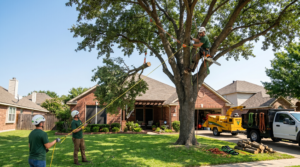
The price isn't really about the tree on its own. It's about how long the crew has to spend rigging, where the limbs can land, and how much equipment has to come in. That's why two trees of the same height can quote three times different prices.
How Much Does It Cost by Tree Size?
Tree size is the single biggest pricing factor. Arborists group trees into four size brackets, and the DFW ranges look like this:
| Tree size | Height | Trunk (DBH*) | Typical DFW cost |
|---|---|---|---|
| Small | Under 30 ft | Under 12 in | $300 to $800 |
| Medium | 30 to 60 ft | 12 to 24 in | $800 to $2,000 |
| Large | 60 to 80 ft | 24 to 36 in | $2,000 to $5,000 |
| Very large or heritage | 80 ft+ | 36 in+ | $4,000 to $8,000+ |
*DBH = Diameter at Breast Height, measured 4.5 feet up from the ground. Trunk thickness drives cutting and chipping time, so a thicker trunk costs more even at the same height.
The mid-size bracket (30 to 60 feet) is the bulk of our work in DFW. That covers most established backyard oaks, elms, and pecans. Once you cross 60 feet, you are usually looking at a crane assist or extensive climbing rigging, and the bill reflects it. For a sanity check, HomeGuide's 2026 size table is consistent with what we see in the field.
How Much Does It Cost by Species?
Species matters because hardwoods take longer to cut, weigh more to rig, and sometimes need extra protective gear. Here are the most common DFW species we remove, with national averages and what we see locally:
| Species | National range | What drives the DFW price |
|---|---|---|
| Live oak / red oak | $250 to $2,500 | Live oaks sprawl horizontally, so there are more limbs to rig. Common in DFW. |
| Pecan | $650 to $2,700 | Tall, heavy, brittle wood. Often near houses. |
| Ash | $800 to $1,900 | Tall (60 to 120 ft). Emerald ash borer makes many removals urgent. |
| Elm | $600 to $3,000 | Hardwood, often very wide canopy. |
| Cedar (Eastern red cedar) | $250 to $2,500 | Softer wood, faster cuts. Common rural or lot-line. |
| Crape myrtle | $150 to $500 | Small, low-risk. Often grouped on the same visit. |
| Bradford pear | $400 to $1,000 | Brittle, so frequent storm-damage removals. |
| Magnolia | $150 to $1,000 | Dense wood but usually small height. |
Species ranges are from Angi and HomeGuide, adjusted for what we actually charge in DFW. A 60-foot pecan over a Plano roofline is a different job than a 60-foot pecan in an open field. Same species, very different price.
Six Factors That Move the Price
Beyond size and species, six things consistently push the quote up or down.
1. Proximity to your house, fence, or power lines. Anything that limits where limbs can fall forces sectional dismantling with ropes, which is slower and more expensive. Tight access can add 25% to 50% to the base price, per HomeGuide's 2026 cost factors.
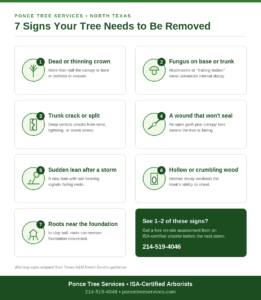
2. Tree condition. A dead or storm-damaged tree is more dangerous to climb because brittle wood can snap under the climber. Dead-tree removals run roughly $800 to $1,600. Not sure whether yours actually needs to come down? Check the signs your tree needs to be removed first.
3. Access for equipment. If a bucket truck or crane can drive to the tree, the job is fast. If the crew has to walk gear in through a side gate, labor hours jump.
4. Hazards near the canopy. Power lines, gas meters, swimming pools, glass roofs, and HVAC units all require extra rigging and protection. We will not cut near a live line, that is a TXU or Oncor job first.
5. DFW clay soil. Expansive clay shifts with drought and rain, which can heave roots, destabilize the root flare, and complicate stump grinding. Soil condition occasionally adds time to a job that looks simple on paper.
6. Disposal. Hauling brush and logs off-site costs money. Most DFW quotes include haul-off. If yours does not, that is a meaningful line item to ask about.
A good written quote names each of these so you can see where your money is going.
What's Included in a Tree Removal Quote?
A complete written quote should cover the tree (or trees) by location on the property, the scope of work (felling vs. sectional dismantling), debris haul-off, lawn protection, proof of insurance, and a clear total. You can see what's standard on a Ponce tree removal quote to compare against any other estimates you get.
Items that are commonly not included, and that you should ask about:
- Stump grinding. Almost always quoted separately. See the next section.
- Surface root removal. Grinding the stump leaves the lateral roots in the ground. Removing them is extra labor.
- Sod or landscape repair. Crews protect the lawn with mats where they can, but heavy equipment leaves marks.
- Permit fees. When required, the city fee is passed through. Our pillar guide covers permit rules for Dallas, Fort Worth, and Arlington.
- Arborist report. If your city or HOA requires a written report justifying removal, that runs about $250 to $500 per tree.
Get the quote in writing, with everything itemized. A round number with no breakdown is a yellow flag.
How Much Extra Does Stump Grinding Cost?
Stump grinding in DFW typically costs $100 to $1,200 depending on stump size, with most jobs falling between $250 and $500. A standard tree removal stops at ground level. The stump and the major surface roots stay behind unless you ask for grinding.
| Stump size | Diameter | Typical DFW cost |
|---|---|---|
| Small | Under 12 in | $100 to $250 |
| Mid-size | 12 to 24 in | $250 to $500 |
| Large | 24 in+ | $400 to $1,200 |
Many DFW crews price stump grinding at roughly $4 to $5 per inch of diameter, with a $100 to $150 minimum. National data from Angi's stump grinding guide is in the same ballpark.
It is almost always cheaper to bundle stump grinding with the removal than to schedule a return trip. We will cover the grinding-vs-full-removal decision in our dedicated stump grinding spoke later in this series.
Emergency and Storm Removal: When the Bill Doubles
Storm response, tree-on-house, and active hazard situations are priced differently than scheduled work. Expect a 50% to 100% premium over a planned removal, plus a mobilization charge for after-hours response.
Typical DFW emergency ranges:
- Standard emergency removal: $800 to $3,000
- Tree on structure (roof, fence, vehicle): $1,500 to $6,000
- Crane-required emergency work: $2,500 to $8,000+
- After-hours or weekend mobilization premium: $300 to $800
If a tree falls on a covered structure (your house, garage, or fence) during a storm, homeowners insurance often pays for the removal and the repair. Do not move the tree before your insurer documents the damage, because premature cleanup can complicate the claim. We provide photos and written documentation for insurance at no extra charge.
We will go deep on storm response and insurance claims in our emergency tree services pillar later in the calendar.
How to Spot a Risky "Cheap" Quote
When one quote comes in dramatically below the others, say 40% or more under the next-lowest bid, ask three questions:
- Are they insured? Ask for certificates for both general liability and workers' comp, and call the insurer to confirm the policy is current. An uninsured worker injured on your property can become a personal liability problem.
- Are they certified? Look for an ISA Certified Arborist on the crew. ISA certification means they passed a rigorous exam and keep up with current standards. "A guy with a chainsaw" is not the same job.
- Where is the wood going? Reputable crews dispose of debris at proper sites, which costs money. Lowballers sometimes dump on vacant lots or charge a "small extra fee" the day of the job.
The cheapest quote rarely stays the cheapest once those costs surface. Compare apples to apples, then choose.
For city-specific guidance, see our pages for Dallas tree removal, Fort Worth tree removal, and Arlington tree services.
Conclusion
Tree removal cost in North Texas is a real number, not a mystery. Small trees run $300 to $800. Mid-size trees run $800 to $2,000. Large mature trees run $2,000 to $5,000, and crane-required heritage removals can go higher. The rest is access, condition, and what is included in the quote.
If you would rather skip the homework and get a real number on your tree, call Ponce Tree Services at 214-519-4046 for a free on-site assessment. An ISA-certified arborist will walk your property, explain what is driving the price, and give you a written quote with no pressure. We serve Dallas, Fort Worth, Arlington, Plano, Irving, and Frisco across the DFW metro.
Frequently Asked Questions
How much does it cost to remove a large oak tree in DFW?
A mature live oak or red oak in the 60 to 80-foot range typically runs $2,000 to $5,000 in DFW, with crane-required heritage oaks reaching $5,000 to $8,000 or more. Price depends on canopy spread, proximity to the house, and whether a crane is needed. Oaks are slow to cut because the wood is dense, so labor hours add up.
Is tree removal cheaper in winter?
Yes, modestly. Crews are less booked in late fall and winter, and dormant trees are easier to assess. National data from HomeGuide suggests off-season discounts of around 10%. The exception is oaks. Avoid pruning or removal wounds on oaks between February and June due to oak wilt transmission risk, and paint any fresh oak cut within 15 minutes.
Does homeowners insurance cover tree removal?
Sometimes. Most policies cover removal if a tree falls on a covered structure (house, garage, fence) during a storm. Routine removal of a healthy or dead tree for maintenance is usually not covered. If a tree falls on your roof, document the damage with photos and call your insurer before cleanup, because premature removal can complicate the claim.
Why are tree removal quotes so different from each other?
Three reasons: insurance coverage (an uninsured crew can quote 40% less because they do not carry the policies), certification level (an ISA-certified arborist costs more than a day-labor crew), and disposal handling (proper haul-off has real costs). When quotes vary by more than about 30%, ask for an itemized scope and proof of insurance to compare honestly.
Can I save money by leaving the wood?
Yes. Keeping the logs for firewood typically saves $75 to $250 on hauling. You can also leave the stump (skip grinding) for another $100 to $400 in savings, although the stump will slowly decay and sprout suckers for a few years. Both are reasonable trade-offs for the right homeowner.
Amaury Ponce is an ISA Certified Arborist and TCIA member with 20 years of tree care experience across the Dallas–Fort Worth metro. Ponce Tree Services is a family-owned, BBB-accredited, fully licensed and insured tree care company serving Dallas, Fort Worth, Arlington, Plano, Irving, and Frisco. Call 214-519-4046 for a free on-site inspection or visit poncetreeservices.com.