Tree Removal in North Texas: The Complete Guide
Introduction
Few things change a North Texas yard faster than losing a tree. Tree removal in North Texas is rarely a casual decision, because one spring storm can split a 60-year-old live oak down the trunk and turn the shade tree your kids grew up under into a hazard leaning over the roof. These are big, heavy, deeply rooted trees growing in expansive clay soil that swells and shrinks with every drought and downpour, and getting one down safely takes real planning.
This guide walks you through every part of the process. You'll learn when a tree actually needs to come down (and when it can be saved), what removal costs across Dallas, Fort Worth, and Arlington, whether your city requires a permit, and how to tell a qualified crew from a risky one.
We've removed thousands of trees across the DFW metro over the past 20 years, from backyard crape myrtles to towering pecans wedged between two houses. The same questions come up every week. Here are the answers, straight from the field. If you'd rather just talk to someone, our DFW tree service team is one call away.
When Should You Remove a Tree in North Texas?
Remove a tree when it's dead, structurally unsound, or diseased beyond recovery, or when it clearly threatens people or property. Warning signs include a dead crown, large cracks in the trunk, fungus growing at the base, major decay, severe leaning after a storm, or roots heaving your foundation. When in doubt, have a certified arborist look first.
Not every struggling tree needs to go. Plenty of trees that look rough can be saved with pruning, treatment, or time. The goal is to tell the difference between a tree that's stressed and a tree that's a liability.
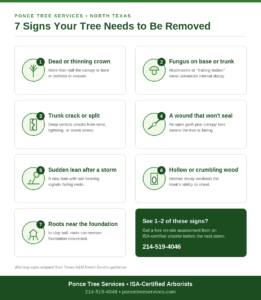
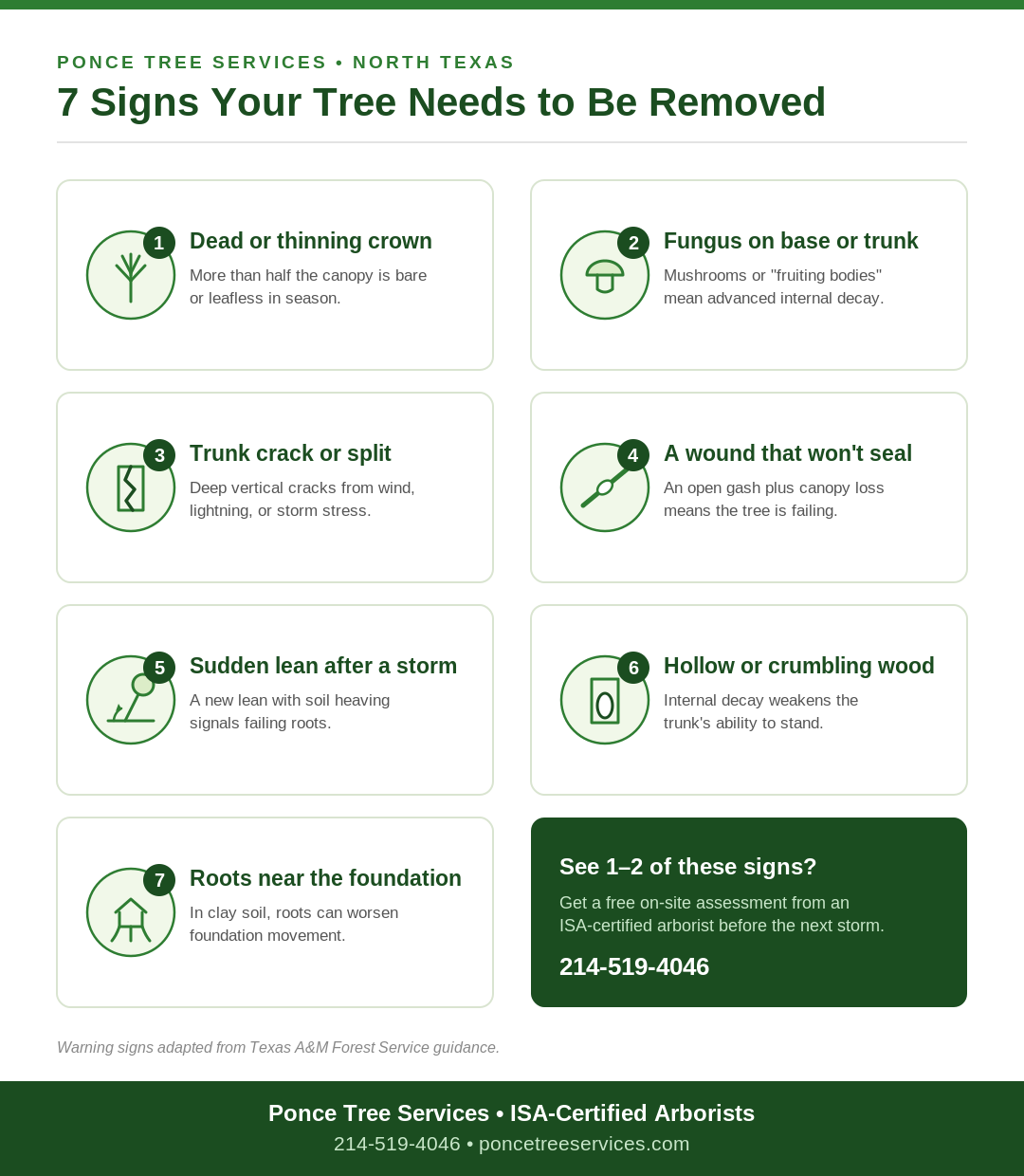
7 Signs Your Tree Needs to Be Removed
The Texas A&M Forest Service points to several clear signals that a tree is failing and should likely come down:
- A dead or thinning crown. If more than half the canopy is dead or missing leaves in season, the tree probably won't recover.
- Fungus or mushrooms at the base or on the trunk. These "fruiting bodies" usually signal advanced internal decay.
- Large vertical cracks or a split trunk. Often caused by lightning, wind, or storm stress.
- A new wound that won't seal. A large, open gash combined with crown loss is a bad sign.
- Leaning after a storm. A sudden lean, especially with soil lifting on one side, means the roots may be failing.
- Hollow or crumbling wood. Significant decay weakens the trunk's ability to hold itself up.
- Roots threatening your foundation. In North Texas clay, aggressive roots can worsen foundation movement, which sometimes makes removal the safer choice.
A dead or unstable tree near a home, driveway, or power line is the most urgent case. These trees can drop limbs (or fall entirely) without warning, and they tend to do it during the same storms that make them hardest to reach.
When a Tree Can Be Saved Instead
Before you remove a tree, it's worth asking whether it can be saved. The Texas A&M Forest Service notes that many storm-damaged trees recover if the trunk is sound and at least half the canopy is intact. A tree with minor limb damage, a treatable disease, or a fixable structural issue is often a candidate for pruning or care rather than removal.
Disease is its own decision. Some conditions are manageable, while others spread fast and put nearby trees at risk. If you suspect a problem, have a certified arborist diagnose the tree before you decide. When the call is close, an ISA-certified arborist can give you an honest read instead of a default "cut it down."
How Much Does Tree Removal Cost in North Texas?
Most tree removals in North Texas cost between $300 and $2,500, with large or hard-to-reach trees running higher. Nationally, tree removal averages around $750 and ranges from about $200 to $2,000 or more, and very large or hazardous trees can exceed that. Price comes down to size, condition, location, and access.
Here's a realistic range for the DFW metro by tree size:
| Tree size | Rough height | Typical DFW cost |
|---|---|---|
| Small (crape myrtle, small ornamentals) | Under 30 ft | $300 to $700 |
| Medium (ash, smaller oaks) | 30 to 60 ft | $700 to $1,300 |
| Large (mature live oak, red oak, pecan) | 60 to 80 ft | $1,300 to $2,500 |
| Very large or high-risk (near structures or power lines) | 80 ft or more | $2,500 to $5,000+ |
These are estimates. For local context, our own tree removal in Plano typically falls in the $300 to $2,500 range, with large oaks and trees close to a house on the higher end.
A few factors push the price up or down:
- Size and height. Taller trees take more time, bigger equipment, and more cleanup. Many companies price partly by the foot.
- Proximity to your house or power lines. A tree in an open field is simple. A tree leaning over your roof or tangled in utility lines requires careful rigging, which costs more.
- Condition. A dead, brittle, or storm-damaged tree is more dangerous to climb and dismantle, which raises the price.
- Access. If a crane or bucket truck can't reach the tree, the crew works harder and slower.
- Extras. Stump grinding and hauling the wood are usually separate line items.
When you compare quotes, ask exactly what's included. A cheap number that leaves you with a stump and a yard full of logs isn't really cheaper. For a full breakdown by service and tree type, see our detailed North Texas tree removal cost guide (coming soon in this series).
What to Expect During Professional Tree Removal
A professional tree removal follows a clear sequence: assessment and quote, permitting if needed, the takedown, and cleanup. Knowing the steps helps you spot a crew that cuts corners.
Step 1: Assessment and Quote
A qualified arborist walks the site, checks the tree's lean, health, and surroundings, and notes any obstacles like fences, sheds, or power lines. You should get a written quote that lists the work, whether stump grinding and haul-off are included, and proof of insurance. A free on-site estimate is standard at Ponce.
Step 2: Permits and Planning
If your city requires a permit (more on that below), it gets handled before any cutting starts. The crew also plans the drop: which direction limbs will fall, where to set up rigging, and how to protect your lawn, beds, and hardscape.
Step 3: The Removal
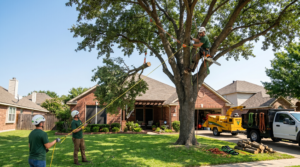
For a tree in the open, the crew may fell it in one controlled direction. For most DFW yards, that's not safe, so the crew climbs or uses a bucket truck and removes the tree in sections, lowering limbs with ropes to avoid the house, fence, and flower beds. This "sectional dismantling" is slower but far safer near structures.
Step 4: Cleanup and Stump
After the tree is down, the crew chips the brush, hauls the wood (or leaves it if you want firewood), and rakes the area. The stump is ground or removed as a separate step. A good crew leaves your yard cleaner than they found it. You can see the full scope of our professional tree removal service and what's included.
Do You Need a Permit to Remove a Tree in Dallas, Fort Worth, or Arlington?
It depends on your city, the tree's size, and its species. In much of North Texas, homeowners can remove smaller or non-protected trees from their own residential lot without a permit, but protected and larger trees often require one. Removing a protected tree without a permit can mean fines and mandatory replanting, so always check first.
Here's how the three primary cities compare:
| City | Permit for homeowners? | Protected-tree trigger | Notes |
|---|---|---|---|
| Dallas | Not required for single-family or duplex lots under 2 acres removing non-protected trees; required for protected trees | Trunk diameter of 8 inches or more (measured 4.5 ft up) | Permit fee is at least $100, with review in about 3 business days and possible replanting or mitigation |
| Fort Worth | Not required for one dead, dying, diseased, or hazardous tree on a single-unit lot under 1 acre | 6-inch DBH and up can trigger review; "Significant" (over 27 inches, or 18 inches for post and blackjack oaks) and "Heritage" trees are protected | The 2025 ordinance update raised penalties to $720 per inch for oaks and $1,200 per inch for other protected trees |
| Arlington | May be required by tree size and species; rules are tied closely to development | Cross Timbers native oaks carry special protection | The city charges about $50 for up to 3 trees and a mitigation fee near $200 per caliper inch for protected trees that aren't replaced |
A quick word of caution: ordinances change, and the details depend on your exact lot and tree. When we handle Fort Worth tree removal or tree removal in Arlington, confirming the permit status is part of the job. A full city-by-city permit comparison is coming later in this series.
Can You Remove a Tree Yourself, or Should You Hire a Pro?
You can safely remove a small tree yourself if it's under about 15 feet, well away from your house, fences, and power lines, and you have the right tools and a clear drop zone. Anything large, leaning, dead, or near a structure or power line should go to a professional. The risk is not worth it.
Tree work is genuinely dangerous. The tree care industry has one of the highest fatality rates of any job, and OSHA reports that falls and being struck by falling limbs are the leading causes of death. Industry data from the Tree Care Industry Association counts 243 tree-care fatalities from 2020 through 2023, an average of about 61 deaths a year, and those are trained workers with proper gear.
The most common DIY mistakes we see are homeowners climbing with a chainsaw, cutting near power lines, or misjudging which way a tree will fall. The Texas Department of Insurance safety guidance stresses staying clear of power lines and using proper protective equipment. A dropped limb can total a roof, and contact with a live line can be fatal. When the tree is big or close to anything you care about, hire a pro. We'll cover the safe DIY line in detail in a dedicated guide later in this series.
How to Choose a Tree Removal Company in North Texas
Not all tree services are equal, and the cheapest quote often hides the biggest risk. Before you hire anyone, check three things: certification, insurance, and reputation. Getting this right protects your property and your wallet.
Look for an ISA Certified Arborist. The International Society of Arboriculture certification means the person passed a rigorous exam and keeps up with current tree care standards. Membership in the Tree Care Industry Association (TCIA) is another strong signal, since accredited companies pass an audit of their safety and business practices.
Insurance is non-negotiable. Always ask for proof of both general liability and workers' compensation, and confirm the policy is current. This matters more than people realize: you can be held financially responsible if an uninsured worker is hurt on your property or if a crew damages your neighbor's home. A legitimate company hands over its certificates without hesitation.
Finally, look for local track record. Read reviews, ask for references in your area, and choose a company that knows North Texas trees and soil. Ponce Tree Services is family-owned, BBB-accredited, fully licensed and insured, and led by an ISA-certified arborist with 20 years in the DFW metro. For more on vetting a crew, see our upcoming guide on how to choose a tree service company in North Texas.
What Happens to the Stump and Debris After Removal?
After a tree comes down, you're left with a stump and a pile of wood and brush. Most homeowners have the stump ground a few inches below grade so they can plant grass over it. Full stump removal pulls the entire root ball and costs more. The crew chips the brush and hauls the wood, or leaves it cut for firewood if you ask.
Stump grinding is the popular choice because it's faster and cheaper than digging out the roots. Nationally, stump removal runs about $195 to $609, often priced per inch of stump diameter. Grinding turns the stump into mulch you can spread or haul away, though the underground roots stay in place and slowly decay.
What you do with the leftover wood is up to you. Some homeowners keep the logs for firewood, while others have everything hauled off. We'll go deeper on grinding versus full removal, costs, and what to do with the leftover hole in our dedicated stump grinding and removal guide.
Tree Removal for Commercial Properties and HOAs
Tree removal isn't just a homeowner concern. Property managers, HOAs, and commercial sites across DFW carry real liability when a dead or damaged tree sits over a parking lot, walkway, or building. A proactive removal plan protects tenants, visitors, and the budget.
For commercial sites, the priorities are scheduling around business hours, managing traffic and safety, and keeping clear documentation for insurance and board records. Our commercial tree removal crews handle HOA common areas, retail centers, and multi-acre properties with the permits, insurance, and reporting these jobs require. A dedicated guide for property managers is coming later in this series.
Conclusion
Tree removal comes down to three decisions: is it time, what will it cost, and who should do the work. If a tree is dead, unstable, or threatening your home, don't wait for the next storm to make the choice for you. Get an honest assessment, understand your city's permit rules, and hire a certified, insured crew that will protect your property while the tree comes down.
Call Ponce Tree Services at 214-519-4046 for a free on-site estimate from an ISA-certified arborist. Serving Dallas, Fort Worth, Arlington, Plano, Irving, and Frisco, with no pressure to remove a tree that can be saved.
Frequently Asked Questions
How much does it cost to remove a tree in Dallas?
Most tree removals in Dallas cost between $300 and $2,500, depending on the tree's size, condition, and how close it is to your home. Small trees sit at the low end, while large oaks or trees near structures and power lines cost more. The best way to know is a free on-site estimate, since proximity and access drive the final price.
Do I need a permit to remove a tree in my own yard in DFW?
Often no, but it depends on your city and the tree. Dallas generally lets homeowners remove non-protected trees on single-family lots under 2 acres without a permit, while protected trees (8-inch trunk or larger) need one. Fort Worth and Arlington have their own size and species rules. Always confirm before you cut, since removing a protected tree without a permit can mean fines and replanting.
When is the best time of year to remove a tree in Texas?
A dead or hazardous tree should be removed right away, in any season. For non-urgent removals, late fall and winter are convenient because trees are dormant and crews have more availability. One important exception: if you're cutting oaks, avoid pruning wounds between February and June due to oak wilt risk, and paint any fresh oak cut within 15 minutes.
Can I remove a large tree myself?
It's strongly discouraged. Large tree removal involves climbing, heavy limbs, and often power lines, and tree care is one of the most dangerous types of work, with falls and struck-by injuries causing dozens of deaths a year. A dropped limb can destroy a roof and contact with a live line can be fatal. For anything large or near a structure, hire an insured professional.
Does homeowners insurance cover tree removal?
Sometimes. Many policies help with removal if a tree falls on a covered structure, such as your house or fence, during a storm. Removing a healthy or simply dead tree for maintenance is usually not covered. Coverage and limits vary by policy, so check with your insurer. We'll cover storm damage and insurance claims in detail in our emergency tree services guide.